

What the IMX742 delivers
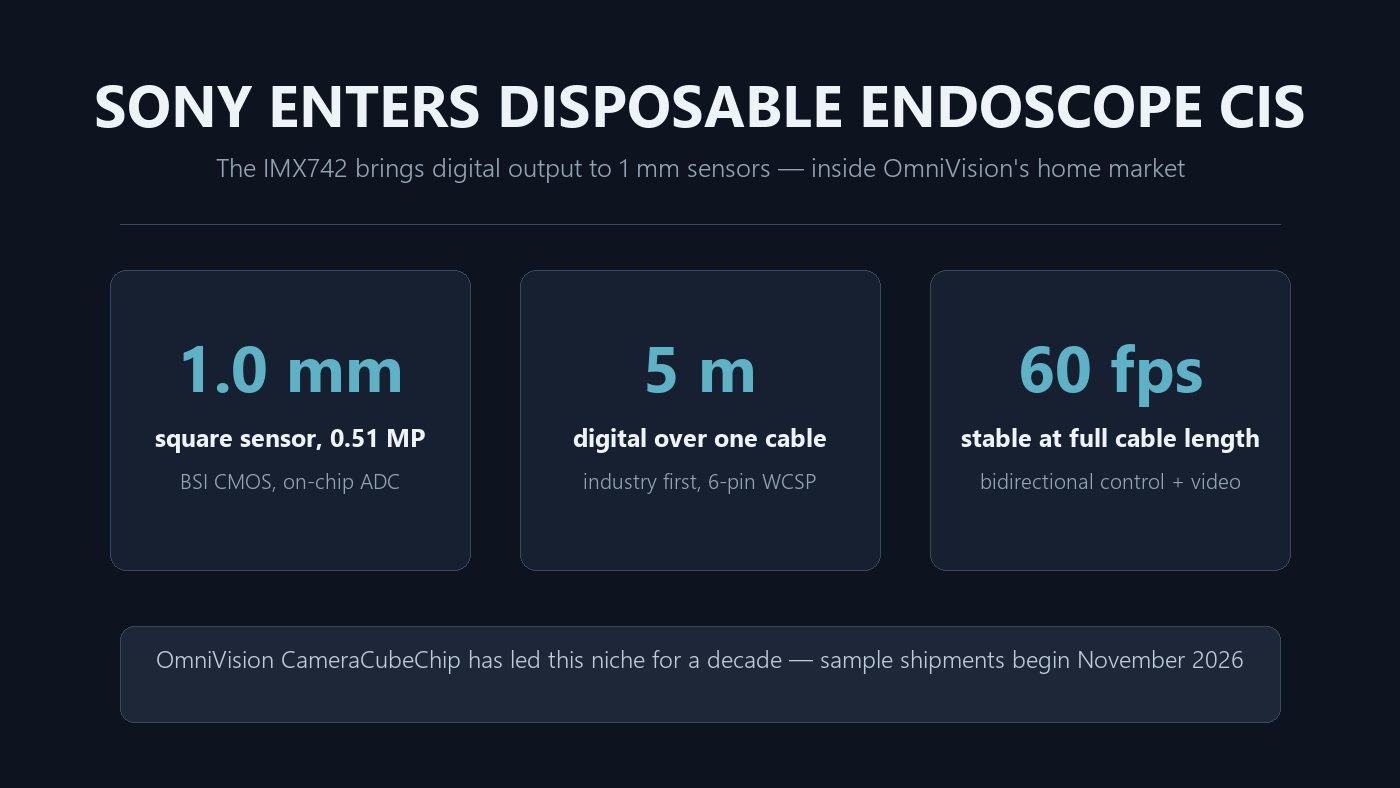
The headline figures from Sony's disclosure:
| Specification | Value |
|---|---|
| Device structure | Back-illuminated (BSI) CMOS |
| Optical format | 1.02 mm diagonal (1/17.7 type) |
| Effective pixels | 720(H) × 720(V), approx. 0.51 MP |
| Pixel size | 1.00 μm × 1.00 μm |
| Chip size | 1.00 mm × 1.00 mm |
| Frame rate | 30 fps / 60 fps |
| Shutter | Rolling shutter with global-reset release |
| Interface | Bidirectional communication, 6-pin WCSP package |
| Transmission | 5 m cable digital transmission (industry first) |
Three things stand out.
First, high resolution and digital output inside an extreme size limit. Digital output means integrating the A/D converter into the sensor itself, and on a one-millimetre die the pixel array and the peripheral circuits compete for every micron of silicon. Sony shrank the converter and surrounding logic far enough to leave the pixel array intact.
Second, and this is the sharpest edge of the announcement: 5 metres of digital transmission over a single cable. Miniature endoscope cameras have traditionally sent analog signals down their long, thin cables, where interference produces grain and vertical lines and buries shadow detail. The IMX742 digitises at the sensor and multiplexes control and video over one cable using Sony's bidirectional communication scheme, compressing the pin count to six while sustaining 60 fps at the full 5-metre run. That distance also gives device makers real freedom in cable routing and trolley layout.
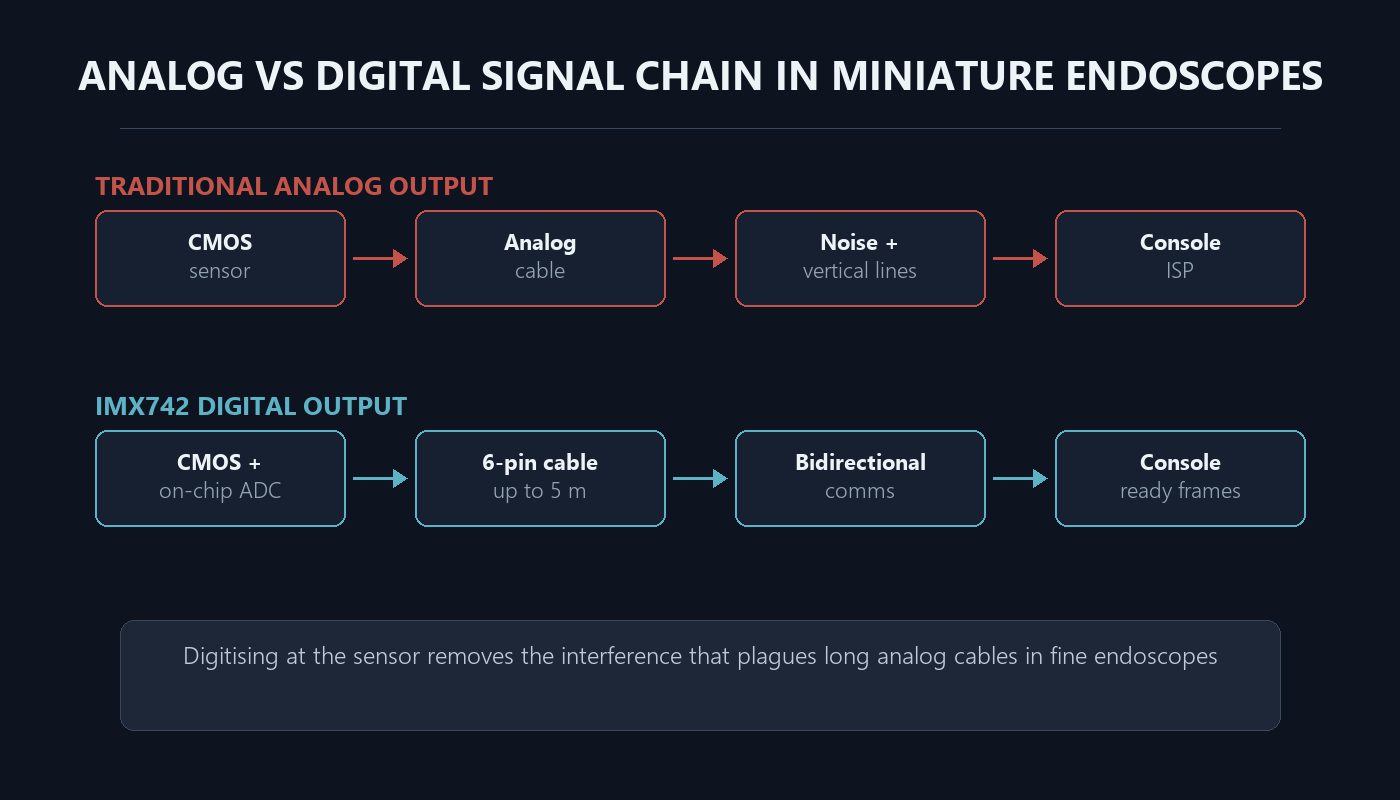
Third, low-light behaviour. Body cavities are dark, and fine scopes such as bronchoscopes and ureteroscopes carry only small LED distal tips. The lower read noise that comes with digital output, combined with the light-gathering advantage of the back-illuminated structure, is what Sony is positioning as the generational step in shadow visibility.
Sony has supplied sensors for reusable endoscopes for years; this is the formal extension of that line into single-use devices.
Why now: the market curve
Commercial single-use endoscopy started in 2009 when Ambu shipped the aScope, the first disposable bronchoscope. Boston Scientific's LithoVue showed in 2015 that the format could carry fine interventional work, and the FDA clearance of the first disposable duodenoscope in 2019 turned reprocessing-related infection outbreaks into a public-health argument for disposability. Since then the wave has spread from bronchoscopes and ureteroscopes to cystoscopes, cholangioscopes, gastroscopes and colonoscopes.
The demand logic is straightforward. Reprocessing reusable scopes is complex and error-prone; single-use devices cut the associated infection risk by 65–80 percent. They also fold reprocessing equipment, labour, repair and downtime into one predictable per-procedure cost, a number that keeps falling as volumes grow and volume-based procurement spreads. And in ICUs, emergency rooms and bedside settings, the device is ready the moment the package opens.
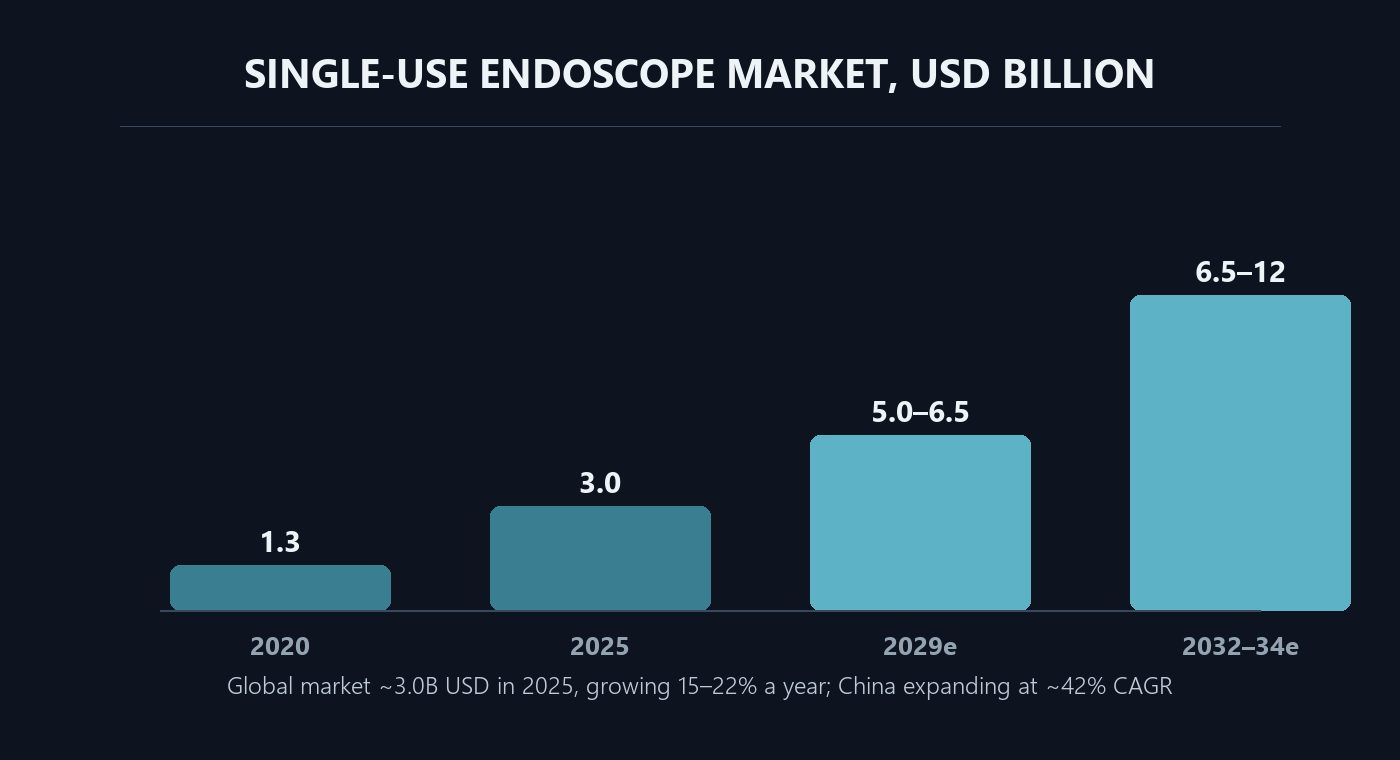
The numbers behind that logic: the global single-use endoscope market was about USD 1.3 billion in 2020 and roughly USD 3.0 billion in 2025, growing 18.2 percent that year. Most forecasts put the compound growth rate at 15–22 percent, reaching somewhere between USD 6.5 and 12 billion by the early 2030s. China is more elastic still: about RMB 1.14 billion in 2024, projected to reach RMB 9.37 billion by 2030, a 42.1 percent compound rate. By the end of October 2025 the NMPA had 366 single-use endoscope registrations on file, 356 of them domestic.
For sensor vendors the deeper attraction is the business model. A reusable system ties one sensor to one console and one scope; a disposable scope consumes a sensor at every procedure. The image sensor stops being equipment and becomes a consumable that scales with surgical volume.
That consumable market is already substantial: QYResearch puts medical-grade CMOS sensors at USD 1.55 billion and about 116 million units in 2024, with margins around 20–25 percent, and single-use endoscopy is its fastest-growing outlet. Frost & Sullivan projects roughly 24 percent compound growth for medical CIS through 2029. A track with rising volume, premium pricing and consumable economics is not one the world's largest CIS maker can watch from the sidelines for long.
The pressure on OmniVision
OmniVision is the incumbent here, and not by accident. Its CameraCubeChip packages the sensor, an ISP and a wafer-level lens into one component small enough to sit at the tip of a 1 mm endoscope, SMT-mountable like any other chip. Around it sits the OVMed medical image signal processor line and Nyxel near-infrared technology for fluorescence-guided work, plus ready-made reference designs — including one for disposable HD video laryngoscopes. In medical device image sensors OmniVision holds roughly 18 percent against Sony's 24, and in the smallest-sensor segment that single-use scopes need most, it leads.
The IMX742 attacks that position on three fronts.
Technical narrative first. OmniVision's story is extreme miniaturisation and integration. Sony has now packed 0.51 megapixels, an on-chip ADC and digital output into a bare 1 mm die, and claimed the industry's first 5-metre digital transmission — planted on the exact ground OmniVision treats as its moat. Analog output has been the soft spot of sub-millimetre designs; on-chip digitisation over six pins is a credible definition of the next step. OmniVision now has to answer it or accept a generational gap.
Then customer mindshare. Sony has decades of history with Olympus, Fujifilm and Pentax, and those reusable-scope leaders are entering the disposable market defensively. When they pick sensors for single-use lines, Sony is the natural first call. Ambu and Boston Scientific have no reason to decline the quality narrative that comes with the brand either.
And scale. Sony's consumer CIS volumes amortise medical process development in a way no medical-only vendor can match. Medical CIS is high in unit value but modest in unit count — a bit over 100 million units a year against billions for phone sensors. Only a company of Sony's size can fund medical-specific process work at what amounts to a discount.
OmniVision is not without answers. Its sensor-plus-ISP-plus-lens-plus-reference-design package fits exactly what the wave of new device makers wants: short time to market and low development cost. Its local supply chain sits next to the bulk of those 366 Chinese registrations. Cost control under centralised procurement is a discipline Sony has yet to demonstrate. And there is time: samples ship in November 2026, and medical design-in to volume typically takes three to five years. The window is real, but it is now measured.
What it means for the rest of the chain
For device makers, the fight is good news. The single-use market is concentrated — Ambu around 30 percent, the top five near 65 — and two CIS giants competing on sensor supply will push image quality up and module costs down at the same time, widening the gap against reusable scopes across more specialities.
For domestic Chinese sensor makers — SmartSens, Gpixel and their peers — the signal is double-edged. China's single-use boom was built partly on the cost advantage of domestic sensors and modules; a higher technical bar at the top of the market is a warning for anyone positioned purely on price substitution. But Sony's medical operation has historically moved slowly and supported mid-size customers thinly, and the large cohort of Chinese device makers still needs suppliers who answer quickly. The likeliest outcome is pressure to move up the stack — on-chip digital output, bidirectional communication — rather than retreat.
As for OmniVision, the anxiety may be productive. A market growing at 24 percent a year can carry several winners, and Sony's entry will advertise the category to hospital buyers who had not prioritised it. The real question is whether OmniVision can hold the "smallest endoscope sensor of choice" position with its own next digital-generation parts before Sony's volume rhythm takes hold.
Related reading: the camera control units and camera heads we build around sensors like these.
Industry reporting via Smart Medical Devices (智慧医械网), October 2026. Market figures as cited therein.