

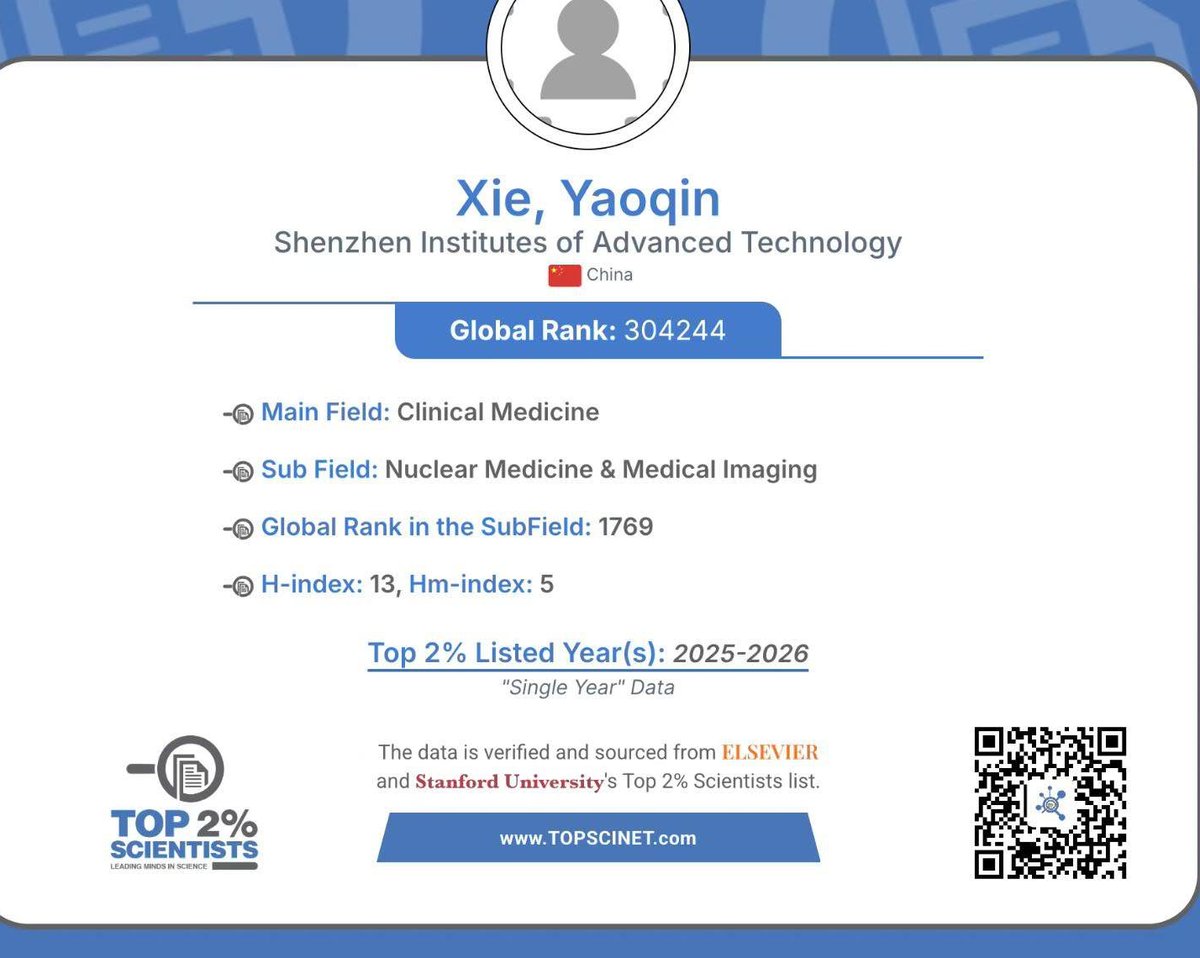
What the list measures
Compiled by a research team at Stanford University using Elsevier’s Scopus citation data, the World’s Top 2% Scientists list covers scientists across 22 broad scientific fields and 174 sub-fields. Ranking is based on a composite citation indicator that weighs total citations, the h-index and co-authorship patterns, and it is published as a publicly available reference on research impact rather than as an award.
A career built on medical imaging and AI
Prof. Xie is a PhD supervisor at the Shenzhen Institute of Advanced Technology (SIAT), Chinese Academy of Sciences, chairs a technical committee of the Chinese Society for Biomedical Engineering (CSBME), and is a two-time winner of the Wu Wenjun Artificial Intelligence Award. His research spans medical image analysis, computer-assisted intervention and intelligent imaging systems — the same ground on which endoscopic imaging products are built.
Why it matters to AelisMed
That research background is not decoration on a brochure. It is what sits behind the image-processing decisions in our products: the 4K ISP pipeline that keeps tissue texture and colour faithful on a surgical display, the algorithms that preserve contrast when ICG fluorescence is fused with white light, and the work that keeps image latency low enough for a surgeon to trust what they see. AelisMed is the endoscopy brand of factory-direct manufacturer NopOpto, and Prof. Xie’s role as chief scientist is to connect the research side to what actually ships.
Our congratulations
Congratulations, Prof. Xie — and thank you for the standard you set for the whole team. If you would like to talk about the imaging technology behind our endoscope camera modules, or about an OEM/ODM project of your own, the AelisMed team is one message away.
Read more on the AelisMed blog Our imaging technology Endoscope imaging products Contact us
From citation metrics to shipped products
The distance between a citation index and a product that ships is where most research relationships stall. Ours is deliberately short. The image-processing judgements in our modules — what the denoise stage is allowed to touch, how the fusion engine aligns white light with fluorescence, which trade-offs keep latency inside a surgeon’s comfort envelope — are made with the same discipline that the listed research applies: measure against a reference, keep what is explainable, and let clinical evidence outrank demo impressions. Readers who want the engineering version of that story will find it in our notes on SoC versus FPGA backends and the 4K imaging chain.
Added 24 October 2026.