

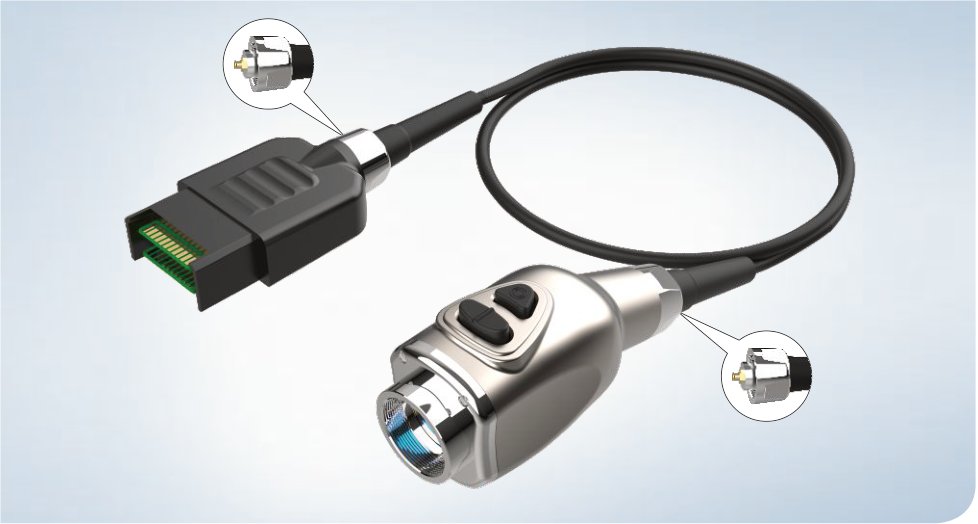
The connector problem
Traditional multi-cable camera heads separate video, power and control onto different conductors. Each connector is one more thing to assemble, one more thing to autoclave, and one more thing that can fail mid-procedure. In a sterile field, re-draping or swapping a cable is not a two-minute inconvenience — it can mean re-processing, re-positioning and lost OR time.
The costs are easy to underestimate because they never appear on a purchase order. They appear as the scrub nurse's third attempt to seat a connector with gloved fingers, as the drape that has to be cut and re-taped around a bulky breakout, as the table space a cable bundle quietly occupies. Over a hundred cases, the friction compounds into a real operational tax — and unlike the camera's image quality, nobody demos that tax before you buy.
Why three cables are harder than they look
Separating video, power and control is not just mechanical bulk. Three conductors entering the same crowded handle means three shielding problems, three grounding paths and three opportunities for interaction. Power lines carry switching noise; control lines are slow but sensitive; the video pair wants silence. Where they run together, each needs isolation from the others, and the isolation hardware lives in exactly the space a miniature camera head does not have.
Grounding is the quiet killer. A multi-cable head wired to a base unit through separate returns can develop ground loops — small potential differences that inject hum and streaking directly into the video. Filters and isolators fix it, until temperature and age move the parameters and it comes back six months later as an intermittent complaint that no one can reproduce on the bench.
What actually travels on one coax
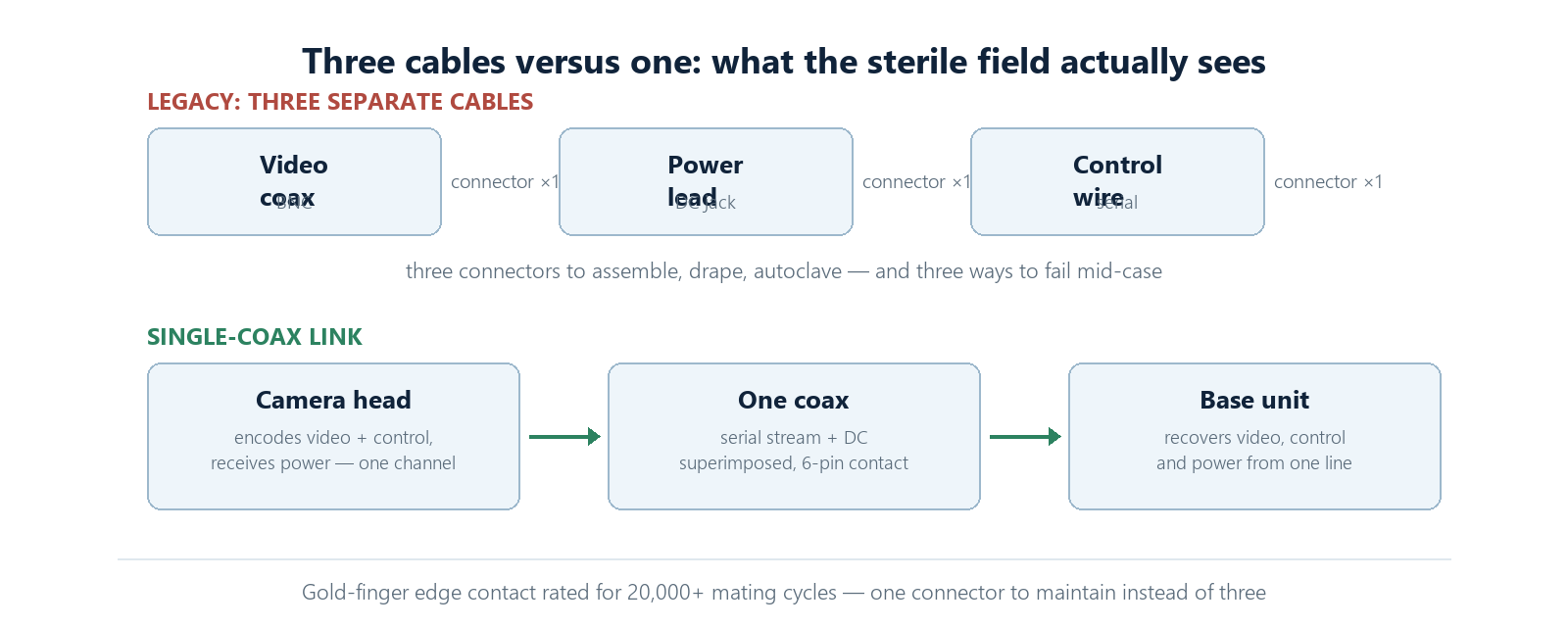
A well-engineered coaxial camera link multiplexes the full 4K/60 video stream, bidirectional control data and module power onto a single conductor pair. The camera head encodes control and video into one high-bandwidth serial stream; the base unit recovers power delivery and telemetry from the same physical channel. Done properly, the surgeon sees no difference — except that setup takes seconds instead of minutes.
Two engineering details make it work. First, superimposed power: DC is coupled onto the same line through isolation networks at both ends, so the sensor and the serialiser at the tip run from the cable they talk down. Second, bidirectionality: control commands to the head and telemetry from it share the channel with the downstream video without contention, which is what lets the head report its own identity, temperature and error state to the base unit — the foundation of any serious fault diagnostics.
The physical layer is unforgiving. At these data rates the cable's high-frequency attenuation is the real specification, and it changes with every bend radius and every mating cycle. A link designed with margin engineers its error rates to stay far below correction capacity across the whole rated cable life — not on day one, on day one thousand.
Gold fingers and mating cycles
The weakest mechanical point in any detachable design is the connector. Gold-finger edge connectors rated for 20,000+ mating cycles survive the reality of a busy department: repeated reprocessing, repeated assembly, occasional rough handling. Special-alloy contacts resist the fretting corrosion that gradually raises contact resistance in cheaper plated connectors — the failure mode that shows up six months after installation as intermittent flicker.
The number to ask about is not just the cycle count but the condition at the end of it: contact resistance after 20,000 cycles in a reprocessing environment is a different figure from the same number on a clean bench. Vendors who have actually run the test publish a drift curve. Vendors who have not, publish a single optimistic integer.
What reprocessing does to a cable
A detachable camera cable does not live a gentle life. It is wiped with disinfectant between cases, immersed for high-level disinfection where the protocol demands it, flexed at the strain relief thousands of times, and occasionally run over by a trolley wheel. Jacket materials matter as much as contacts here: some common PVC jackets stiffen and craze after repeated exposure to the same disinfectants that leave polyurethane untouched. The cable that survives is specified as a system — jacket, strain relief, contact plating and bend radius chosen together against the department's actual reprocessing protocol, not against a generic wipe-down.
A short checklist before you trust a "single-cable" claim
- Is video, power and control genuinely on the one cable, or does a separate power line hide in the spec sheet?
- What is the rated mating-cycle count, is it measured or extrapolated, and what is contact resistance at the end of the rating?
- Is the cable itself rated for your reprocessing method — not just wipe-down — and by which jacket material?
- What happens when the link degrades: graceful fallback, or black screen? Does the head report link health to the base unit?
- Can one cable length serve your room layouts, or does signal integrity force a change of cable between rooms?
Single-coax design is not marketing; it is a genuine reliability upgrade. But like everything in endoscopy, the details on page three of the datasheet are the ones that decide whether it survives your department.
Related reading: the camera heads this link serves and how the camera control unit recovers the stream.