

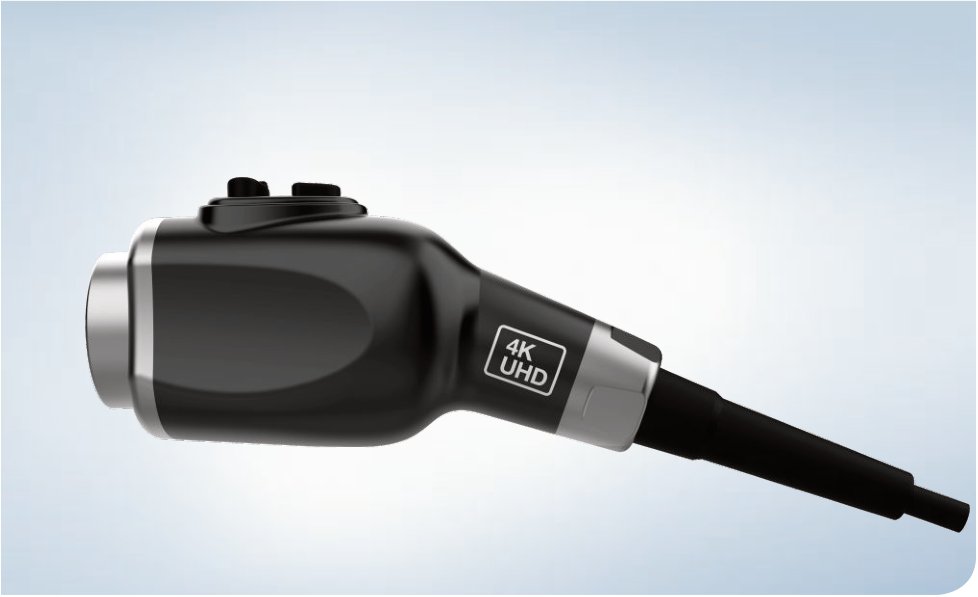
The reprocessing gauntlet
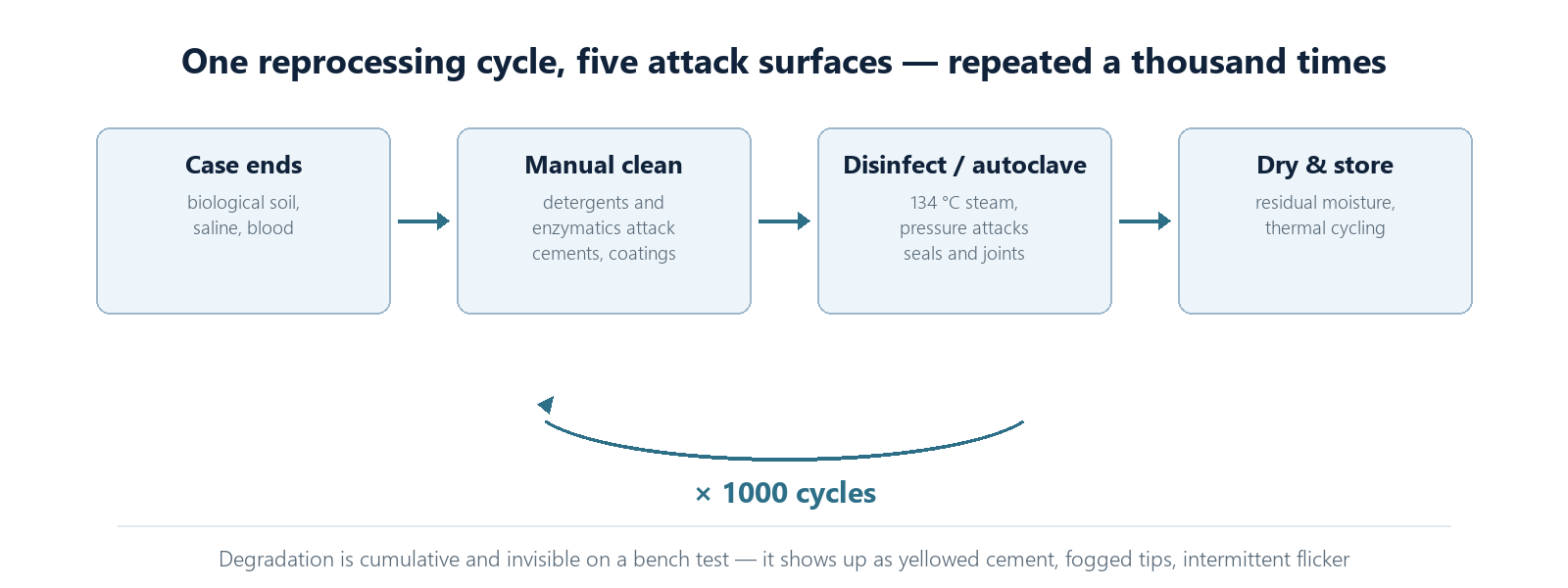
Between cases, an endoscope goes through manual cleaning, high-level disinfection or steam sterilization, drying and storage. Each stage attacks a different material property: detergents and enzymatic agents attack cements and coatings; heat and pressure attack seals and adhesive joints; repeated thermal cycling fatigues everything with a different expansion coefficient.
The frequency deserves emphasis. A busy service runs this cycle many times a day, every day. A thousand cycles is not a stress test in any laboratory sense — it is roughly the first year of a moderately used scope. Materials specifications that look robust in a catalogue are being asked to survive a decade of daily chemical baths and pressure excursions, in sequence, without a rest day.
Steam, plasma and chemicals are not interchangeable
Reprocessing methods are often discussed as one category. They are not. Pressurised steam at 134 °C delivers high heat plus rapid pressure swings plus moisture in one package — the most aggressive common cycle, and the one that exposes every adhesive joint. Hydrogen peroxide low-temperature processes trade heat for oxidative chemistry, which attacks specific polymers and coatings that steam would ignore. High-level disinfectant immersion is chemically gentler per cycle but runs more cycles and immerses for longer. A module validated for one method can fail another, and "reprocessable" without naming the method is a phrase with no information content.
When evaluating a camera module or scope, match the validation to your department's actual cycle — the named method, the named parameters, the named number of cycles. The most expensive sentence in endoscopy procurement is "it should be fine, ours is similar".
Where optics actually fail
Failure rarely looks dramatic. Objective lens cement slowly yellows, shifting colour balance and cutting transmission in the blue channel. Anti-reflective coatings micro-crack where the housing flexes. Seals around the distal tip relax a fraction of a millimetre — enough to admit fluid during immersion, which fogs the optical path from the inside. None of these appear on a bench test at room temperature an hour after reprocessing; all of them appear across a thousand cycles.
Each has a characteristic presentation that helps field diagnosis. Cement yellowing shows up first as a colour-temperature shift the white balance chases but never quite catches, worst in the blue channel. Coating micro-cracks appear as faint scatter halos around bright specular reflections. Seal ingress announces itself as fogging that appears mid-case and clears after drying — intermittent at first, then permanent. Recognising them early turns a replacement decision into a service decision.
Materials and designs that survive
The modules that hold up share three traits: optical cements rated for the full autoclave temperature range rather than "chemical disinfection only"; bonded rather than screwed seals at the distal tip; and housings machined so that thermal expansion does not work against the optical alignment. Sensor modules sealed as a single potted assembly avoid the internal condensation that plagues vented designs.
The unbonded seal deserves a special mention, because it fails in the least visible way. A compression seal held by a threaded retainer survives bench testing perfectly and then walks loose over thermal cycles, a fraction of a degree of rotation at a time. Bonded joints — chemically bonded, with a cement rated for the full temperature range — do not have a rotation to give up. The design difference costs little at manufacture and everything at year three.
How to read an ageing claim
Manufacturers validate lifetime claims in two honest ways: real-time cycling on production-representative units, or accelerated ageing with the acceleration factor stated and justified. Both are legitimate; vagueness is not. A credible claim names the method, the cycle parameters, the sample size and the pass criteria — typically transmission drift, seal integrity and image quality after the rated cycles. Claims without those specifics are marketing sentences wearing a lab coat.
One practical cross-check costs nothing: ask which parts of the module are serviceable and at what cost. A design that expects eventual cement or seal replacement at a scheduled interval is telling you its engineers understand wear. A design that promises indefinite performance with no service concept is telling you its marketing department wrote the durability section.
What to demand from a datasheet
"Autoclavable" is not a spec. The meaningful claims are specific: a rated number of sterilization cycles at a named temperature and pressure, transmission drift tolerances across the rated lifetime, and a stated IP rating for immersion at working temperature. A vendor who publishes those numbers has tested them. A vendor who writes "withstands common reprocessing methods" probably has not.
Related reading: the imaging modules and camera heads we build for the full reprocessing cycle, and the field guide to image artifacts that ageing eventually produces.